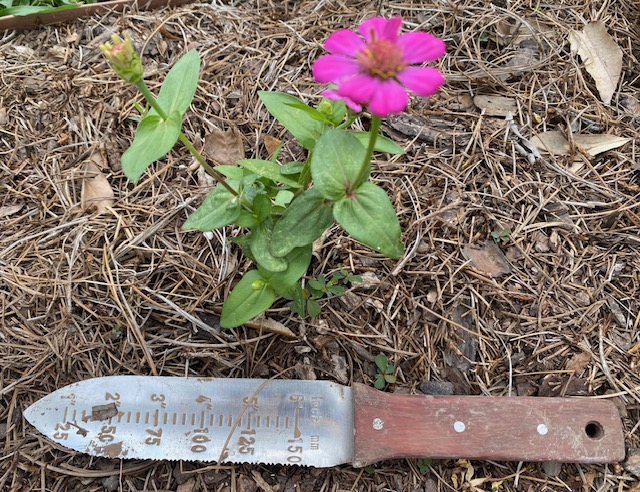
If I was stranded on an island and could only bring one garden tool with me it would be my hori hori knife, also known as a Japanese gardening knife. In Japanese the word hori means “to dig” and is an onomatopoeia in that language that represents the sound of digging. I have been using a hori hori for gardening for the last few years and it is absolutely indispensable part of my gardening toolkit. These simple, versatile garden implements can be used for many tasks when establishing and maintaining garden beds, including removing roots, preparing bed borders, digging holes for plants, dividing plants, planting rows of seeds, and harvesting fruits and vegetables. A hori hori knife is a sublime garden tool that will make your gardening tasks easier – and they also make a great gift for the avid gardener.
Origins of the Hori Hori Gardening Knife
In Japanese society, hori hori knives have been used for centuries to maintain gardens and forage for wild plants, vegetables, and trees in the mountainous landscapes of Japan. The knives got their name from the word hori in Japanese, which is an onomatopoeia that represents the sound of digging. In Japan they are also referred to as sansai knives, with the word sansai translating to “mountain vegetable”.
Their importance as a garden tool and likely weapon of self-defense in Japanese society cannot be overlooked. In the Middle Ages, armed mercenaries were abundant and threatened the power of nobility in feudal Japanese society. In response, Emperor Toyotomi Hideyoshi decreed a ban on katana and other types of weapons. However, the hori hori was exempt from this ruling due to their importance for farming and protection among the general population.
In addition to their use as a tool of subsistence and protection, hori hori knives have been used to harvest tree seedlings to create Bonsai trees. Over time, gardening developed into a cultural artform, and the hori hori knife became akin to a painter’s brush. The Japanese art of creating and sustaining gardens developed into a distinct cultural practice that showcases natural, harmonious landscapes. Japanese gardening practices are derived from ancient indigenous Shinto beliefs that ancestral spirits, referred to as Kami, inhabit the landscape. Natural garden features, such as water, stone, and plants, offer contemplative and tranquil sacred spaces for people to commune with the Kami. Around the 6th and 7th centuries, Chinese gardening practices diffused to Japan along with Buddhism. It was during this time that ancient Japanese and Chinese practices integrated to create the Japanese-styles of gardening known today. In the mid-1900s, Japanese gardening practices gained popularity in Western countries and the hori hori knife became a tool of choice for many gardeners.
A Multi-Purpose Gardening Tool
The design of these knives is what makes them a mainstay in many gardening toolkits. Hori hori knives are sturdy, stainless-steel knives that are typically around 6-7 inches (17 cm) long. One side of the blade is straight and sharp while the other side is serrated. The serrated side of the knife is ideal for cutting or sawing through small to medium sized roots or woody stems, while the smooth side works well for general digging and planting in flower and vegetable beds. My favorite detail about hori hori knives is that many of them have rulers etched in them to help determine soil depth when planting annuals and seeds. As they are 6-7 inches long, you can also lay them flat and use the ruler to measure ideal spacing between plants.
A few years ago, I installed composite landscape edging around my front flower beds. Initially, I envisioned using a large shovel to handle the task. I quickly realized the large shovel was only acceptable for creating the initial trench for the border, but my hori hori was crucial for ensuring the edging was installed straight and at an even depth. As the process progressed, I ditched the large shovel and relied solely on my hori hori for this project. It was a more efficient tool and it allowed me to create more precise trenches for the edging, especially when I needed a tool that could hack or saw through shrub roots and break up compacted soil.
Before I began my garden edging project, I established seven new garden beds on my property. I bought my cottage-style home because I saw its potential, but the landscape was underwhelming and neglected. While creating the new garden beds I used my hori hori knife throughout the entire process. It was invaluable for tracing and cutting an outline for the beds through the lawn, and lifting pieces of sod that needed to be removed to create balanced borders.
Once I built up my flower beds with tilled soil, compost, and enriched dirt, my hori hori knife helped me easily dig holes to plant perennials and annuals. To plant seeds, I run the tip of my knife along the soil at a 45° angle to create a trench at the appropriate depth for whatever seed I’m planting. You can use the ruler on the face of the knife to verify you have the correct planting depth. Then, I spread the seeds along the trench, cover them with soil, water, et voilà!
As you can tell, all the other implements in my gardening toolkit have been neglected for a long time. My multi-purpose hori hori knife takes care of all my gardening needs! I can just grab it and my gardening gloves and get to work on whatever project I’m tackling at the moment.
 Jardin & Cuisine
Leave a comment