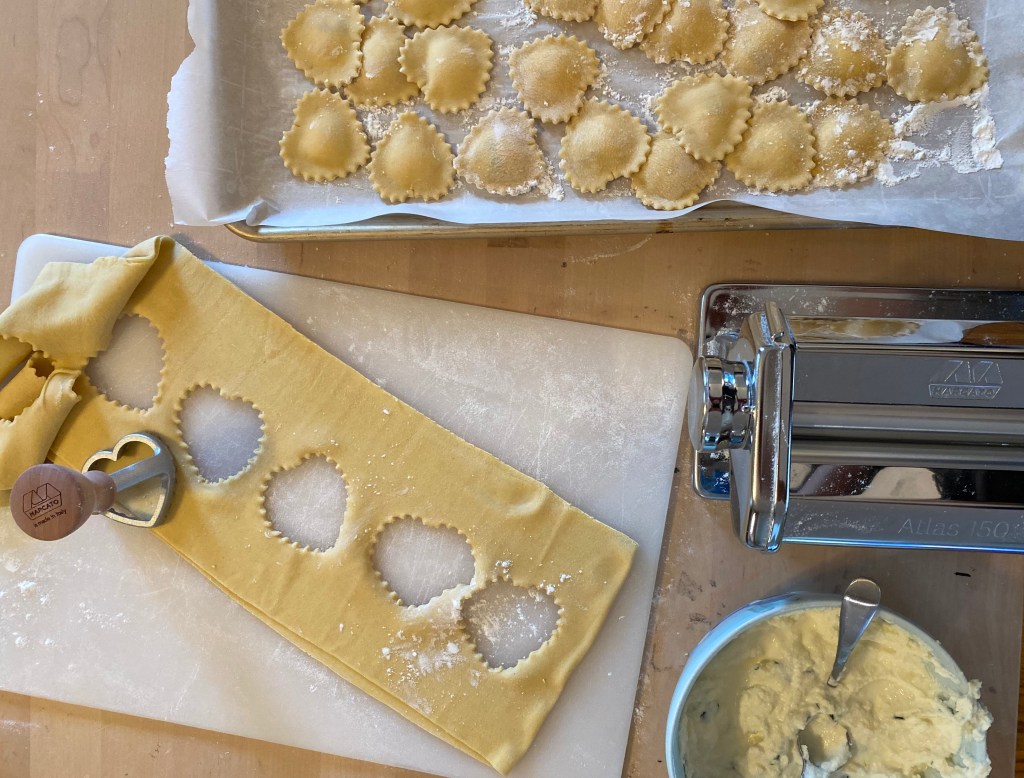
One of my favorite weekend activities is spending an afternoon making pasta. A few years ago I received a Marcato Atlas pasta machine as a gift. Since then, any chance I get I cajole friends to join me for a pasta-making session. Actually, they usually request to join me because the end product – whether it is savory stuffed ravioli or tagliatelle – is always delicious. Plus, my friends learn the art of pasta-making and they always leave my home with a content belly and with a cache of pasta to put in their freezer for another day.
Pasta-making is an adaptable practice and it involves several choices and pathways to the finished product. First, you need to decide if you want to use a stand mixer or countertop to create your dough. The stand mixer method works well if you are making a double batch for more copious amounts to save for later. You can also combine the ingredients to form and knead the dough on the countertop, especially if you are making quick pasta strands for a single dish. Personal preference is also important here, as some people enjoy the more traditional method of crafting and kneading pasta dough by hand. In the recipe I share below I provide instructions for both options.
The ingredients for pasta are simple – flour, eggs, and a little water as needed. It is crucial to not add salt to the dough, especially if you are using a pasta machine as this will amplify the gluten in the dough and create an undesirable texture. Plus, when cooking pasta it is standard practice to add a generous amount of salt to the boiling water. Also, in my experience room temperature eggs make the ingredients easier to integrate and form a smoother dough. It’s worth the wait to bring your eggs to room temperature if they were in the fridge. Once the dough is made and has rested, it is ready for the pasta machine. First, you must decide whether you want to make strands of pasta or simply create sheets of pasta to make ravioli or lasagna. I often make a double batch of pasta and make ravioli and strands of pasta. Then, I cook some and freeze the rest for another meal.
Pasta makers come in many forms, from stand mixer attachments, to electric machines, to more conventional manual machines like my Marcato Atlas. Again, individual preferences vary so pick a method for rolling and shaping your pasta that best suits your needs. Given the different types of machines and their proclivities, it is best to follow their unique instructions for rolling and cutting pasta. Below is a basic recipe for making pasta dough, either by hand or with a stand mixer. I’ve also included a malleable recipe for ravioli filling so you can make a simple ricotta-based ravioli filling or a filling with the complementary ingredients of your choice (e.g. sausage, spinach). As the ricotta filling is easily adaptable, I encourage you to experiment with a wide range of flavors. However, the only non-negotiable for the ravioli filling is that you must strain the ricotta to prevent a soupy pasta filling.
Recipe for Pasta
Ingredients
- 10 ounces of all-purpose flour, plus extra for kneading and rolling
- 3 room temperature eggs
- water
Steps
By Hand
- Place the flour on your sanitized countertop to form a mound. Then, create a crater in the center of the mound and add the eggs.
- Whisk the eggs with a fork until they are beaten, while slowly integrating flour from the inner walls of the mound into the eggs.
- Once the flour and eggs are combined, knead the dough by hand for a few minutes, or until a smooth dough forms.
- Wrap the dough in plastic wrap and let it rest on the counter for a minimum of 15 minutes to no longer than 2 hours.
- Follow the instructions from your pasta machine, or roll out by hand into thin sheets, to make your pasta of choice.
With a Stand Mixer
- Add the hook attachment to your mixer. Then, add flour to the mixing bowl and begin to stir on the lowest setting.
- Whisk the eggs in a small bowl. Then, add them to the bowl to combine with the flour.
- Increase the mixer speed slightly for kneading and allow the mixer to knead the dough into a soft ball. If the dough is too dry, add a teaspoon of water at a time until the dough forms and becomes smooth.
- Wrap the dough in plastic wrap and let it rest on the counter for a minimum of 15 minutes to no longer than 2 hours.
- Follow the instructions from your pasta machine, or roll out by hand into thin sheets, to make your pasta of choice.
Basic Ravioli Filling
Ingredients
- 15 ounces of whole milk ricotta, strained for 6-8 hours in a fine mesh strainer or cheesecloth.
- 2 ounces shredded parmesan reggiano
- Salt and pepper to taste
- See options below for ingredients to flavor your ravioli filling. Or, you can enjoy the simplicity of plain ravioli.
Steps
- Combine the above ingredients into a mixing bowl. Then, you can add any of the following to your basic ravioli filling:
Italian Sausage Filling
Add 1 link of cooked Italian sausage to the ricotta mixture. Make sure to drain any excess moisture and oil from the sausage on a paper towel after cooking.
Spinach and Cheese Filling
Add 1-2 cups of fresh spinach to the ricotta filling. Before adding, wilt the spinach in the microwave with 1 tablespoon of water and squeeze by hand to remove excess moisture.
Lemon and Herb Filling
Add a handful of fresh or 1 tablespoon of dried herbs of your choice to your filling. I recommend parsley, tarragon, sage, or basil. You can also add 1 teaspoon of lemon zest to the ricotta mixture.
2. Roll out pasta dough into two long sheets. It should be sturdy enough that it will hold the dough without tearing, yet not too think that your ravioli will be overly chewy.
3. Add 1.5 teaspoons of filling to the pasta sheet spaced far apart enough that you can seal the ravioli well around the filling.
4. Gently swipe water around the outside of the filling.
5. Place the second sheet of pasta on top of the sheet with the filling and carefully press around the pockets of filling to remove air and to seal the sheets of pasta around the filling.
6. Then, you can cut your ravioli with a stamp, crimper, or simply use a knife for a more rustic looking ravioli.
7. Add the ravioli to a large pot of salted, boiling water and gently boil for approximately 3 minutes, or until al dente.
8. Sauce, serve, and bon appétit!
 Jardin & Cuisine
Leave a comment